
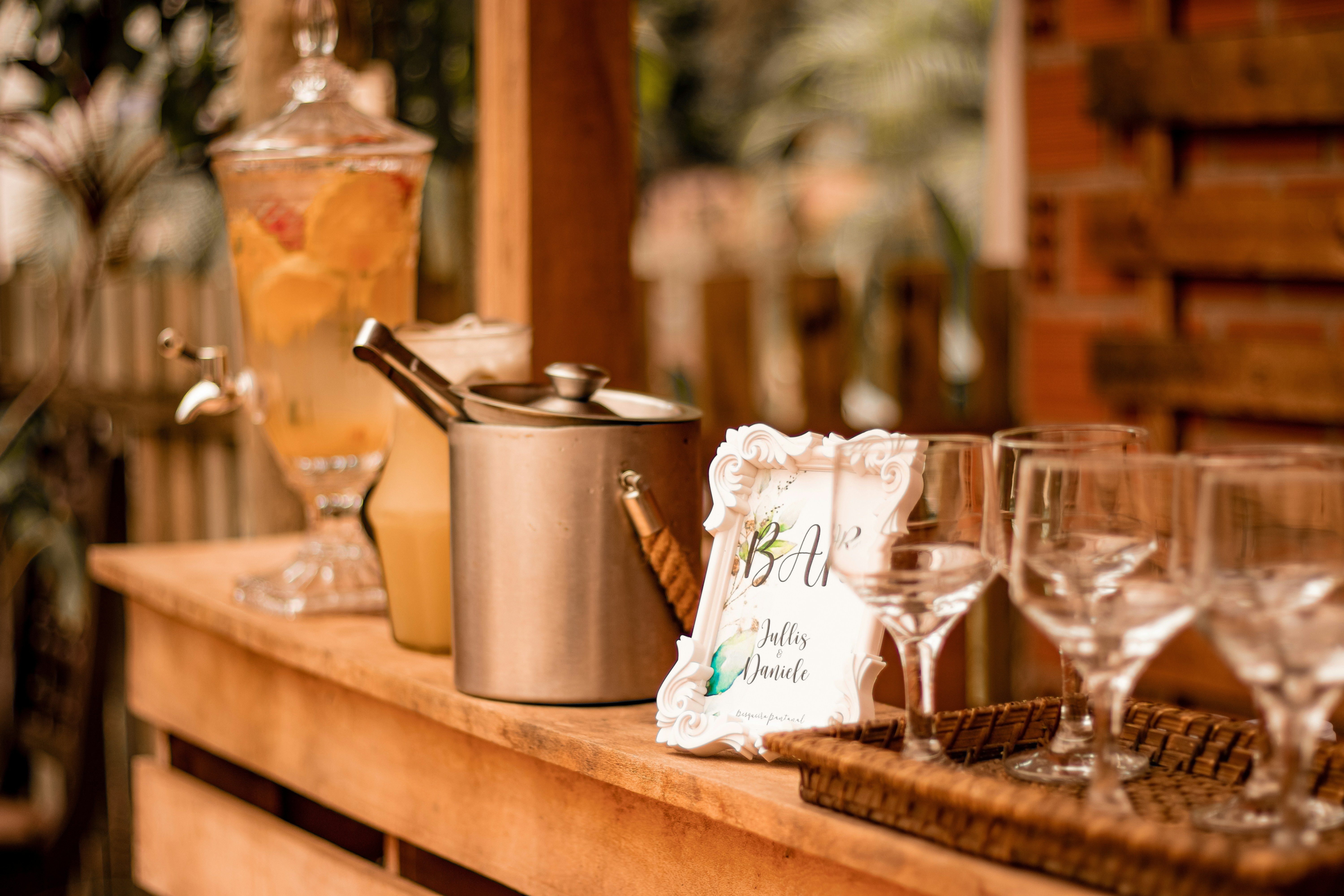
There are certain parts of wedding planning that seem incredibly simple until you actually have to plan them.
The bar is one of them.
At first, it sounds like an easy checkbox: Open bar? Beer and wine? Signature cocktails? Done.
Then the questions start.
Who buys the alcohol? How much do you buy of each type? Does the bartender bring the ice? What about mixers? Who provides the glasses? How many bartenders do you actually need?
Turns out, “we’ll have a bar” is less of a simple decision and more of the beginning of several decisions.
So, before you sign a bar package, or make a very expensive trip to the liquor store, here are some details worth figuring out.
Start With What Your Venue Actually Allows
Before you spend much time designing signature cocktails or pricing out cases of wine, find out what your venue permits.
Some venues handle alcohol entirely in-house, or maybe just some of the alcohol. For example, I got married at a winery and had to use their wine (of course), but could bring in everything else. Other venues require you to use an approved caterer or bar service. Some couples supply their own alcohol (🙋♀️), which can save money, but also leaves you responsible for more logistics.
Ask your venue:
- Can we provide our own alcohol?
- Are we required to use a particular bartender or bar service?
- Are there corkage or service fees for outside alcohol?
- Are there insurance or licensing requirements?
- Who is allowed to serve the alcohol?
- Are shots permitted (if you want shots to be permitted…..think about it)?
- What time does bar service have to end?
- Is alcohol allowed during cocktail hour and the reception?
- Who is responsible for removing leftover alcohol at the end of the night?
Don’t Just Ask What the Bar Costs. Ask What the Price Includes.
Two bartending quotes can look similar until you realize one includes ice, mixers, garnishes, cups and setup while the other is essentially providing a person who pours drinks.
The Knot’s list of questions to ask a wedding bartender specifically recommends asking about things such as setup and breakdown, glassware, ice, mixers and garnishes rather than assuming they’re part of the package.
That distinction matters even more with mobile bartending services and venues that allow you to bring your own alcohol.
Before comparing prices, find out who is supplying:
- Alcohol
- Mixers
- Ice
- Garnishes
- Glassware or disposable cups
- Cocktail napkins
- Straws or stirrers
- Coolers or refrigeration
- The physical bar itself
- Water and nonalcoholic beverages
- Setup and cleanup
A cheaper quote isn’t necessarily cheaper if you’re responsible for supplying half the bar yourself.

How Much Alcohol Do You Actually Need?
This is probably the question that sends the most couples to Google.
A commonly used starting point is approximately two drinks per adult guest during the first hour and one drink per hour after that. Here Comes The Guide, for example, uses that guideline for estimating a BYO wedding bar.
For a five-hour reception, that could mean planning around six drinks per drinking guest.
But ultimately, it’s a planning estimate, not a prediction.
You know your guests better than an online calculator does.
A Sunday brunch wedding with a large number of children and nondrinkers is not going to consume alcohol at the same rate as an evening reception full of your college friends.
If you allow shots, you’ll likely need more liquor than if you don’t.
Your bartender, caterer or alcohol retailer may be able to help you adjust quantities based on:
- Number of adult guests
- Reception length
- How many guests actually drink
- Whether you’re serving beer and wine or a full bar
- Your guests’ preferences
- Season and weather
- Whether alcohol is also served during cocktail hour
The Knot also offers a wedding alcohol calculator specifically for estimating beer, wine, liquor and sparkling wine quantities based on your event.
One other question worth asking your retailer: Can unopened alcohol be returned? If the answer is yes, buying a reasonable buffer becomes considerably less stressful.
Your Guest Count Doesn’t Tell the Whole Story
Guest count matters, but so does how your guests will use the bar.
Imagine 125 guests leaving your ceremony and entering cocktail hour at almost exactly the same time.
That’s very different from 125 people wandering up to the bar periodically over the course of dinner and dancing.
There’s no single bartender-to-guest ratio that works for every wedding. The Knot cites a general guideline of one bartender for every 35–50 guests, but notes that staffing should also depend on the type of bar service you’re offering and whether drinks such as wine or Champagne will be passed to guests.
And adding bartenders isn’t your only option. If your venue and budget allow, multiple bar locations can help keep guests from congregating in one long line. You can also take some of the pressure off the bar during cocktail hour by having servers pass wine, Champagne, or other ready-to-serve drinks as guests arrive.
Ask your prospective bartender:
“Based on our guest count, drink menu, and how our event is structured, what staffing and bar setup would you recommend to keep service moving? Would we benefit from an additional bar location or having some drinks passed during cocktail hour?”
You’re not just paying someone to make drinks. You’re paying to avoid having 40 people standing in line while cocktail hour happens without them.
A Bigger Drink Menu Isn’t Always a Better One
While you may want to please all your guests and ensure you have something for everyone, it is very easy to get carried away here.
Vodka! Gin! Bourbon! Tequila! Three wines! Four beers! His cocktail! Her cocktail! A champagne wall!
And suddenly your bar needs an enormous inventory and your bartender is making complicated cocktails to order while a line forms.
You don’t have to offer every possible drink to have a generous bar.
Beer and wine with one or two signature cocktails can give guests plenty of choice while simplifying purchasing and service. If you’re considering signature drinks, ask your bartender whether they can be partially or fully batched ahead of time.
And choose cocktails that make sense for the event.
A beautiful drink requiring six ingredients, muddled herbs and an elaborate garnish may photograph wonderfully on Pinterest. Making 80 of them during cocktail hour is another story. And for the record, Pinterest is not real life!

Please Don’t Forget About the Ice – or the Water!
Ice may be the least glamorous wedding expense in existence.
It is also surprisingly easy to underestimate.
You need ice not only in drinks, but potentially to chill beer, wine and other beverages throughout the event. The amount you need can vary substantially depending on your setup, the weather and what refrigeration is available. This is one of those areas where it’s better to ask the professionals involved in your particular wedding than blindly follow an online formula.
And while you’re talking about ice, ask about something even more basic: water.
How will your guests actually get it?
Will your venue provide pitchers or water stations? Is the tap water what will be served, or is there filtered water available? Will water be available at the bar, on the tables, or somewhere guests can easily help themselves? Who is responsible for keeping it filled throughout the reception?
It’s easy to spend hours deciding between Sauvignon Blanc and Pinot Grigio while assuming the water will somehow take care of itself. It won’t.
Ask:
“Who is providing the ice and drinking water, how will guests access both, and who is responsible for replenishing them throughout the event?”
This is especially important for outdoor weddings, backyard receptions and DIY bar setups.
Because “we have plenty of alcohol but it’s all warm, and nobody can find water” is not the wedding memory anyone is hoping for.
Give Nondrinkers Something Better Than an Afterthought
A well-planned wedding bar isn’t only about alcohol.
At minimum, guests should have easy access to water and standard nonalcoholic beverages. But if you’re already putting thought into signature cocktails, consider whether one can also be made alcohol-free—or whether you want one genuinely fun zero-proof option on the menu.
This isn’t just for guests who never drink. Someone may be pregnant, taking medication, driving, participating in sobriety, or simply not feel like drinking that night.
And nobody should have to explain why they’re ordering something without alcohol.
Find Out What Happens at the End of the Night
Here’s another detail that’s easy to miss until the reception is almost over:
What happens to everything that’s left?
If you purchased the alcohol, determine ahead of time who is responsible for packing it up and where it’s going. The same goes for rented glassware, bar equipment, unopened mixers and anything else you’ve supplied.
Also ask when last call happens.
Your venue may have a firm alcohol cutoff, and your bartender may recommend stopping service before the reception itself ends. Knowing that ahead of time lets your DJ or coordinator incorporate last call naturally instead of discovering at 9:57 that the bar has to be closed at 10:00.
Questions to Ask Before Hiring a Wedding Bartender
When you’re comparing bartenders or mobile bar companies, don’t limit the conversation to price and availability.
Ask:
- What exactly is included in your package?
- Based on our guest count, drink menu, and how our event is structured, what staffing and bar setup would you recommend to avoid long lines?
- Do you provide the physical bar?
- Who supplies alcohol, mixers, ice and garnishes?
- Do you provide glassware or cups?
- Will you help us determine how much alcohol to purchase?
- Can you create or help us choose signature cocktails?
- Can signature cocktails be batched to speed up service?
- What nonalcoholic options can you serve?
- How much time do you need for setup and breakdown?
- Do you carry liability insurance?
- Are there any licensing requirements we need to handle?
- How do you handle guests who have had too much to drink?
- What happens to leftover alcohol at the end of the night?
- Are gratuity and service charges already included in the quote?
- Are there any additional fees we haven’t discussed?
And, as always, get the answers that matter to you in writing.
The Goal Isn’t the Biggest Bar. It’s the Right Bar.
Your guests probably aren’t going to leave your wedding talking about how many varieties of vodka you stocked.
They will notice if they spend cocktail hour waiting in line.
They’ll notice if the bar runs out of something halfway through the reception. They’ll notice if there’s no water nearby. And your budget will certainly notice if you pay for far more alcohol and staffing than your wedding actually needs.
The best wedding bar isn’t necessarily the most elaborate one. It’s the one that fits your guest list, your budget and the kind of celebration you’re actually planning.
And once you’ve figured out exactly what’s included in each proposal, comparing your options becomes a whole lot easier—which is true of almost every wedding vendor you’ll hire.
Leave a Reply